• Home
  • YouTube Lessons
  • Patreon Courses
  • Buy A Course
  • Meet Marco
  • BlitzGuitar Login
  • Patreon Login
  • Menu
    • Udemy Courses (2018)
    • Free Beginner Guitar Lessons
    • Free Fingerstyle Guitar Lessons
    • Free Fingerpicking Exercises
    • Free Fingerpicking Scales
    • Free Fingerpicking Chords
    • Fingerstyle Questions

marcocirillo@blitzguitar.com

FINGERSTYLE GUITAR LESSONS

With Marco Cirillo
  • Home
  • YouTube Lessons
  • Patreon Courses
  • Buy A Course
  • Meet Marco
  • BlitzGuitar Login
  • Patreon Login
  • Menu
    • Udemy Courses (2018)
    • Free Beginner Guitar Lessons
    • Free Fingerstyle Guitar Lessons
    • Free Fingerpicking Exercises
    • Free Fingerpicking Scales
    • Free Fingerpicking Chords
    • Fingerstyle Questions

About BlitzGuitarAdmin

This author hasn't written their bio yet.
BlitzGuitarAdmin has contributed 625 entries to our website, so far.

Captivating Spanish Guitar intro in A minor | Create Beautiful Melodies

Captivating Spanish Guitar intro in A minor | Create Beautiful Melodies

Mar 10, 2018

Captivating Spanish Guitar intro in A minor

Create Beautiful Melodies

This weekend is Spanish guitar.

I had so much fun playing this captivating Spanish guitar intro on my acoustic guitar that I thought it would be a good idea to share this lesson with my tribe.

We will be working on the most played chord Spanish chord progression in A minor: Am – G – F – E, and I will show you how you can create beautiful Spanish guitar intro using the question and answer concept.

This intro follows a particular structure that I call “question and answer,” where two ideas communicate with each other to create a beautiful contrast between the two melodies.

This weekend is going to be awesome!

You can check this lesson down below and also learn the second part of this beautiful Spanish Solo on Guitar.

Enjoy!

The Video

Part 1 – Intro –

Part 2 – Melody –

Spanish Guitar Intro

Structure and Chords

One of the things that will help you create a beautiful Spanish guitar intro is learning how to structure the chords and melody so that they sound beautiful together.

In this example, I am going to use the “Question and answer” music concept in which the melody always follows the chord.

This simple musical approach is of paramount importance for many different reasons.

  • It gives structure to the intro.
  • It will help you with dynamics and tone.
  • It helps the audience to connect with the music.

The Question and Answer Explained?

In the tab below, I am going to show you the difference between the question and answer and why it works so well with this Spanish guitar intro.

The chords, marked with the red square, represent the question. Play the chords and let them ring out nicely. Pause for enough time and avoid jumping to the next bar.

The melody is marked with the yellow square, and we will refer to it as the “answer.” Play the phrase fluently without posing in the middle.

Spanish Guitar Intro Question and Answer musical idea

The Chord Progression

The chord progression is straightforward Am – G – F – E. 

One thing that I like to do is to play the chord and let it ring out nicely before I start playing the melody.

Pause between the chord and melody to emphasize the “question and answer” so that the audience can connect with the music better and follow the structure.

What’s next?

What happens after the intro

I while ago, I have recorded a video called “Spanish Guitar Solo on Acoustic Guitar.” In this video, you will find the intro I am showing you today plus the next part right after the solo.

Here is my performance of the Spanish guitar solo.

Good Luck!

Advanced Spanish Melody on Guitar | Fingerstyle Guitar Lesson

Advanced Spanish Melody on Guitar | Fingerstyle Guitar Lesson

Mar 9, 2018

Advanced Spanish Melody

Are you up for the Challenge?

Today I want to challenge all my guitar students with this beautiful advanced Spanish melody on acoustic guitar in A minor.

As you probably know, I love to play around with this simple chord progression that is so characteristic and full of passion.

There are hundreds of different ideas that guitar players come up with when playing around with these chords, and today, I am going to show you one of my favorites.

This Spanish guitar lesson is not for beginners. However, I encourage everyone to give it a try as it is always important to challenge yourself and try things that push you out of your comfort zone.

You can play this advanced Spanish melody on either Classical or Acoustic guitar.

Let’s get started.

The Video

The Chord Progression

Same Old Chords

One of the things you hear a lot when listening to Spanish guitar is the same chord progression repeated over and over again.

Hundreds of different melodies and songs were written using the same 4 chords, and today, it’s no exception.

We will be playing over the Am – G – F and E7 most popular Spanish chord progression.

The Advanced Spanish Melody

Once you familiarize yourself with the chord progression, move on to the melody.

There are two different phrases.

  1. The first phrase is played in thirds and starts on the actual chord.
  2. The second phrase is played in single notes, and it moves towards the next chord.

Advanced Spanish Melody on Guitar

Simplified Melody For Beginners

This lesson is definitely not for beginners.

Two many things make this lesson difficult, so if you have played for just a couple of months, I highly recommend you come back when you feel ready.

However, if you feel you really want to try this guitar part, I suggest you try to simplify the melody like that.

Simplified melody for Beginner

Advanced Spanish Melody on Acosutic Guitar - Easy arrangment for beginners.


The Happiest Melody on Guitar | Chords that Make you Smile

The Happiest Melody on Guitar | Chords that Make you Smile

Mar 8, 2018

The Happiest Melody on Guitar

Simple Melody that Makes you Smile

What’s the happiest melody on the guitar? Today I will show you how to play a simple melody that sounds happy, fun to play, and perfect for beginners.

I was inspired by traditional African music, one of the most beautiful and inspiring music to listen to and play.

It sounds so positive and happy.

Today I want to share with you this simple melody that I came up with this morning while practicing over a chord progression in A major. Honestly, the simple melody could be a little bit better, but I didn’t have a lot of time to work on it.

I hope you are going to like it.

Grab your guitar and play along.

Enjoy.

The Video

The Chord Progression

This is one of the easiest chord progression you will find on the guitar.

A – D – A – E

The thing that makes this chord progression so happy and the simple melody so enjoyable is how we will play these chords using triads.

You see, guys, chords, and just a bunch of notes that sound good together, but they are not musical unless we make them.

We will be using an exciting right-hand approach that I call “palm muting fingerstyle,” We will mute the strings with the palm and pluck the strings with the thumb and index finger.

First of all, let’s start by analyzing the chord progression and learn how to play it using triads.

The Easy Triads

The first part of the melody will be played using three triads.

A major, D major, and E major

You can really decide to play the triads starting from any note, but we will follow a simple pattern where the chords are mainly played starting on the bass note.

Check the guitar diagram to learn the simple triads.

Simple melody playing using triadsgood

Palm Muting

One of the things I love the most about playing this music style is the “muffled” tone achievable with fingerstyle palm muting technique.

It is of paramount importance that you learn how to perform this technique correctly.

It is the same approach as the palm muting on electric guitar, with the only difference that we bill be plucking the strings with index and middle finger rather than use the pick.

Check the picture to learn more about the “Palm muting fingerstyle technique.”

Fingerstyle Palm Muting on Acoustic Guitar


The Easiest Melody for Beginners | Simple Guitar Melody for Beginners

The Easiest Melody for Beginners | Simple Guitar Melody for Beginners

Mar 7, 2018

The Easiest Melody for Beginners

Simple Guitar Melody for Beginners

Today I want to show you what I think is the most simple guitar melody that beginners can learn on fingerstyle acoustic guitar.

Every time I want to record a new lesson, I google it to see how other guitar teachers approach the topic. I don’t do it because I want to get the idea from them, but just see if somebody else teaches the same way I do.

Nothing exciting came up.

It looks like the majority of guitar teachers think of “Simple Guitar Melody” as a one-string melody or simple guitar riffs.

I don’t think that way, and today, I want to show you that “simple” can also be exciting and fun to play.

This lesson was inspired by the most popular song on classical guitar, “Spanish Romance.”

I have re-adapted the melody to make it more “pop” and simple to play so that any beginner guitar player can give it a shot and play something that sounds simple and musical.

Super excited!

Let’s get started.

The Video

Technical Features

The Simple Guitar Melody

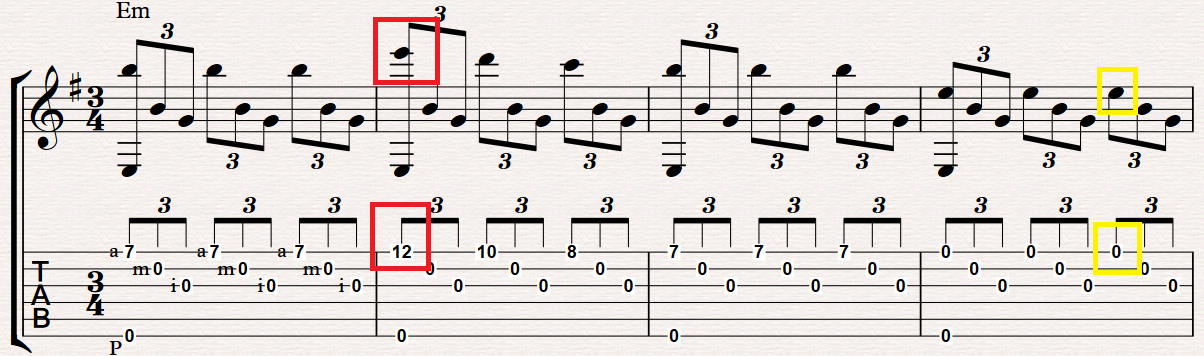
The exercise is based on a simple idea in E minor entirely played on the first string (E), with the note range going from position one (fret 1) all the way up to fret 12.

Check the note range here. The note in red on bar number 2 is played on fret 12, which is the highest note you will be playing. The yellow color represents the lower note, E open string.
Note range for the simple guitar melody in E minor. Higher and lower note on fretboard good

Three Strings Bar Chord

You will also encounter a three strings bar chord that will challenge your finger’s strength and stretch.

This is probably the most difficult part for beginners and a great opportunity to practice and improve your bar chord technique.

Keep the thumb straight down behind the neck and keep the index finger straight. Your strength will slowly improve.

Bar chord technique in red.

Bar Chord in A minor playing a simple melody on guitar

For Beginners

To all my beginner followers who want to learn this simple melody but are afraid it will be too difficult for them.

Don’t freak out! Just start.

Without challenging yourself, you will name feel you are moving forward.

Face this challenge with a positive mindset and practice the difficult parts slowly.

My goal with this lesson is to make you feel like a “Non-Beginner” anymore.

This simple guitar melody pushes you right at the edge between beginner and intermediate, so if you want to take a step forward, learn it, record it, and share it with the world.

It will make you feel good.

Good luck, guys.

Stretchy Chords that Sound Beautiful | Fingerstyle Guitar Lesson

Stretchy Chords that Sound Beautiful | Fingerstyle Guitar Lesson

Mar 5, 2018

Stretchy Chords that Sound Beautiful

Can you play them?

Chords are an amazing tool that any guitar player can use to create beautiful chord progressions or melodies.

One of the things I love the most is experimenting with different chord progressions and trying to come up with chords that sound “different” than the one I already know.

In this example, I will show you how you can spice up this simple chord progression in E major with some beautiful Stretchy Chords that sound nothing like the chords you already know.

You will need to slowly stretch your fingers if you want to play them correctly so, take your time and don’t rush.

If you are a beginner, I highly recommend coming back when you know more about basic chords and all the extensions Maj7, min7, 7, 9, 11, 13, and alt chords.

Grab your guitar, and let’s get started.

The Video

The Chord Progression

From Simple to Advanced

Now that you watched the video and what to play, I will get more into details and analyze the chord progression and show you how to play the chords.

The progression is Emaj7 – Amaj7 – C#m7add11 – Badd9 – C#m7add11 – Amaj7 – Emaj9 – Badd11

Each chord looks pretty simple on paper but waits until you play them.

Check the first 4 chords. IMPORTANT The last chord is actually a Badd9 chord and not a Bsus mentioned in the video and tab.

Stretchy Chords that Sound Beautiful

Spice up with Arpeggios

The second part of the chord progression is played with a nice arpeggio that sounds perfect with the chords.

Stretchy chords sound much better when arpeggiated.

Arpeggiated stretchy chords on acoustic guitar

Get the full tab

Stretchy Chords

Chords that Sounds like a Melody E minor idea

Chords that Sounds like a Melody E minor idea

Mar 4, 2018

Chords that Sounds like a Melody

E minor idea

Let’s keep exploring different ways to make chords sound like a beautiful melody and how you can use your fretboard knowledge to transform simple chords into melodic weapons.

Today’s video is about creativity, fingerstyle, melody, chords, and the number one thing that will make you sound different from any other guitar player around. Musicality.

Chords are just a bunch of notes that sound good together. They are not musical unless you learn how to make them sing, and today, I want to share with you what I know about this wonderful way of playing guitar.

Grab your instrument and play along.

Let’s get started.

The Video

How to Create Melodic Chords

Intervals and Open Strings

Melodic chords are chords that sing.

Learning how to use simple triads melodically is a weapon that every guitar player should know. Not only because your chords will sound amazing and “different” but because you will learn more about the stuff you play.

Knowledge makes you a wiser guitar player.

With knowledge comes creativity, momentum, and fulfillment.

Let’s analyze the chord progression that you are about to learn.

Chord Progression

We are working on a very simple and “popular” chord progression.

Em, D, Am, B7, D# Dim

Each chord will be played in a different position that allows me to make it more melodic.

Open strings are significant!

Check the diagram to learn the chords.

Melodic Chords Guitar Diagram

The Fingerstyle Pattern

Chords are just a bunch of notes played together unless you find a way to make them sing.

The number one technique you can use to do that is fingerstyle.

Plucking the strings individually will make this chord progression extremely melodic and enjoyable to play and listen to.

This is how it is going to look like on paper.


Good Luck!Chords that Sound like a Melody E minor

I hope you will enjoy this lesson, guys.

Creativity is essential in music, and I hope to help you become a better guitar player.

Honestly, I am really enjoying these lessons!

How to Play Licks in Between Chords | Fingerstyle Guitar Lesson

How to Play Licks in Between Chords | Fingerstyle Guitar Lesson

Mar 3, 2018

How to Play Licks in Between Chords

Fingerstyle Guitar Lesson

Is it simple to play licks in-between chords? How do I get started?

I get this question all the time, so I spent the last few days thinking about a way to explain that in simple steps.

Improvising over a chord progression is an easy task if you have a backing track playing along, but how can we combine playing chords and soloing at the same time?

One of the things that I find interesting about this topic is that the majority of teachers out there talk a lot about chords and scales.

They give you the chord progression and the relative scales; then they ask you to come up with your phrases and licks … as it was easy.

The one missing piece is rhythm and repetition.

You can become better at playing licks between chords if you understand the importance of rhythmic pattern, structure, and repetitions.

Playing a ton of notes isn’t the answer, and knowing the scale and chords isn’t enough to truly understand how to combine chords and guitar licks.

We will be focusing a lot of getting your rhythm right so that you can slowly learn how to improvise over a chord progression using fingerstyle acoustic guitar.

Let’s get started.

The Video

Step 1

The Chord Progression

The first step to get started is memorizing the chord progression perfectly.

We will be playing the exercise in the key of D major, and the chord progression is pretty simple and “famous.”

D major, B minor, A major and G major.

Simplify the Chords

Let’s simplify the chords to the bone so that you can truly focus on your goal, which is getting the licks between the chords.

I like to get rid of the entire chord so that I only end up playing the root note of each chord.

The Bass note should always be played at the beginning of each bar and only on the first beat so that you can leave the remaining three beats for the solo.

Simplify chords and focus on playing licks between chords

Step 2

The Scale

Start familiarizing yourself with the relative scale we will be using over this chord progression.

We are in D major key, so the scale we will be using is the D major scale. We will only be playing the scale on three strings and in just one position.

I like to organize the scale that way, so it is easy to play the chord and solo within the same position.

The number one mistake you can make is to try to play the solo up and down the neck without any reference, and that would make the whole exercise difficult.

Check the D major scale here.

D major scale over three strings.

Play the Scale over the Chord Progression

One thing you should to really familiarize yourself with the scale and chord progression is to play the scale on each chord.

This exercise is essential because it helps you to understand the space between the chords and how to fit in the scale and eventually, the licks.

Go ahead and practice the scale with the chord progression.

Make sure the chord is always on the first beat and the scale on the third beat.

How to combine scales and chords together with guitar licks

Step 4

Musical Ideas

This step is exciting and musical. You will probably find yourself spending a lot of time practicing this musical concept.

As we said at the beginning of the lesson, rhythm is the key and so let’s transform this scale into licks by using different rhythmic patterns and melodic ideas.

Keep the Same Rhythm

The first thing I usually recommend doing is to play the same lick over the chord progression. By doing that, you start training your fingers to switch between playing the chord and the phrase.

Same phrase over different chords

Keep the same rhythm

Diversify the Phrase

The next move should be playing the same rhythmic idea but over a different set of notes.

In this example, the rhythm is the same for each note, but the notes are different and played around the chord.

Step 5

Play the Full Chord and Use different Techniques

Step 4 provides you with enough material that you can use to start developing your improvising skills. I highly recommend you stick to step 4 for a while.

The last step is more about putting it together and improvise using the chords and guitar techniques that are more difficult and advanced.

I will play a few examples on the video to show you how to do that.

Enjoy this lesson, and as always, guys, take things step-by-step.

Vivaldi The Four Season Largo on Acoustic Guitar

Vivaldi The Four Season Largo on Acoustic Guitar

Mar 2, 2018

Vivaldi The Four Seasons Largo

On Acoustic Guitar

Another classical piece that we can rearrange on acoustic or classical guitar. Since I started uploading some classical lessons, you guys have been asking for more.

I have been mainly posting pieces from the classical guitar repertoire, so today, I really wanted to try something different and explore a different composition.

I had a ton of fun rearranging this song by Antonio Vivaldi, an Italian composer who wrote some of the most beautiful concerts for violin as well as over 300 compositions for cello, flute, viola, mandolin, and lute.

The piece we are learning today is from one of his violin concerts called The Four Seasons, a group of pieces, each of which gives a musical expression to a season.

I have rearranged one of the Winter season called “Largo,” a beautiful slow melody that can be perfectly played on acoustic and classical guitar.

Technical Features

With this piece, you will be learning a very melodic and expressive melody in the key of C major, which is perfect if your goal is to familiarize yourself with vibrato and over-ringing technique.

The chords are straightforward.

Listen to my interpretation of the Four Seasons, Largo movement on acoustic guitar.

The Video

Learn This Piece

You can learn this song inside the membership area.

The membership gives you access to all the courses and programs available on BlitzGuitar.com, as well as all the upcoming lessons that I post weekly.

The Four Seasons by Antonio Vivaldi is a series of 10 videos where I show you how to break down the piece into different sections to learn the melody, rhythm, and chords slowly and with consistency.

Musical Hammer On on Guitar | Better or Worst than the Old Chromatic Exercises?

Musical Hammer On on Guitar | Better or Worst than the Old Chromatic Exercises?

Mar 1, 2018

Musical Hammer On on Guitar

Enough of Boring, Mechanical Exercises

Another day to work on our technique and musicality.

Honestly, guys, the more I am recording this type of video, the more I think this is such an awesome way to practice and play guitar.

Working hard to find a musical way to practice any guitar playing aspect is becoming my mission!

Today we are checking out how to practice the hammer-on technique in the most musical way possible.

The problem I have with the 90% of the hammer on exercises out is that they are the same old mechanical and boring exercises that guitar players have been practicing for years.

I think it’s time to find a new musical solution to practice this useful technique, and today’s hammer on exercise will blow your mind.

Really important!

I will break it down so that most of you will find this exercise simple to play, but if you are a day one beginner, you might want to come back in few months and start with an easier exercise.

And now, without further ado, here is the musical hammer-on exercise on fingerstyle acoustic guitar.

The Video

How to Practice

There are three things that you really have to consider while practicing this hammer on exercise. These three things work together, so missing one point will make the technique hard to achieve.

Here are the three key points:

  1. Left-hand angle
  2. Hammer on approach
  3. Plucking pattern

You will have to consider the way your left hand should be positioned to perform the hammer-on technique correctly.

Keep the palm very close to the bottom neck with the finger close to the frets. This position allows you to smack the fret powerfully you’ll need to do to hammer.

Also, keep the left-hand thumb straight behind the neck so that you can fully control the fingers when performing the hammer.

Start by practicing the movement first without plucking the strings. Do that until the point you feel comfortable, then start plucking the strings.

2. Hammer on approach

The hammer on should sound as loud as a picking note.

There are two movements that you really have to focus on when practicing the hammer-on technique.

The first movement is the hammer on itself, which should be precise, strong, and performed with control. The second movement is the ability to hold the hammered note so that it rings out nicely.

Try to land the finger close to the fret so that the notes ring out fully and hold the fingers down.

3. Plucking Pattern

The way you pluck the strings is of paramount importance if you want to make the hammer sound smooth.

For this example, the right hand will pluck the strings alternating the index and middle finger throughout. The only exception is the hammered note, which isn’t plucked.

The only way you can achieve a good plucking control is to practice the pattern slowly. Try to play everything as evenly as possible.

6 Expensive Fingerpicking Pattern you Should Learn

6 Expensive Fingerpicking Pattern you Should Learn

Feb 28, 2018

6 Expensive Fingerpicking Pattern

The Art of Plucking

Let me show you the 6 fingerpicking patterns that I played nonstop since I started playing guitar.

No matter how many new things I learn, I always find myself going back to the same few fingerpicking patterns I have played for years. It could be because they are my favorite or because I know them really well.

The fact is, you don’t need to know hundreds of fingerpicking patterns. I honestly think you don’t even have to know fifty or even thirty patterns.

Ten fingerstyle patterns are the number that really works for me. If you add a few variations for each pattern, you can develop a lot of useful fingerpicking weapons that you can use every time you need it.

In this video, I am going to show you the six fingerpicking patterns I love the most.

I am not only going to show you the pattern. You know I wouldn’t say I like this type of teaching approach.

Instead, we will put it into practice and play something musical that you can learn immediately. The tabs are on the screen and a close up on the right hand to show you the fingerpicking pattern.

Let me tell you. This is probably one of the lessons I love the most.

Let’s get started.

Get the Tab here


The Video

The First Gallop

Thumb, index, middle, and ring.

Definitely, one of the most important fingerpicking patterns you will ever learn. This pattern is of paramount importance if your goal is to get started with fingerstyle or improve your plucking technique.

The secret sauce isn’t the pattern itself but the chord progression you are about to play with the fingerpicking pattern.

Fmaj7(#11) – Amadd9 – Am/G

This chord progression works perfectly with this fingerstyle pattern for two reasons.

The chords maintain a constant spaciness that really makes this pattern sound different and more complex.

The open strings also make this chord progression great for a simple fingerpicking pattern like this one. Clusters and semitones sound harmonically beautiful, so there is no need for busy plucking.

Harmony does it all!

Get the Tab here

The Happy Friend

Thumb, and – mid – rin together, Thumb slap, Thumb.

This is one of my favorite fingerpicking patterns for many different reasons.

First of all, it’s a happy pattern that sounds quite jumpy and groovy even if you play it with muted strings.

The thumb slap adds a lot of rhythm and fancy percussion without really changing the dynamic and integrity of the chord progression.

I honestly think that one of the most difficult things to control when using fingerstyle is the ability to stick with the pattern and try to reproduce the same dynamic and tone for each chord or melody you play.

This fingerpicking pattern is an example of how important it is to balance the thumb movement with the fingers and the percussive approach.

Chord progression: G – G/B – Cadd9 – D

Get the Tab here


The Piano Pattern

Plucking the Strings Simultaneously

One of the most interesting fingerpicking patterns is the “plucking together” movement, usually based on the sixteenth note rhythmic value.

It sounds so easy to play when you listen to it,  yet it isn’t easy to get it right if you don’t have fingers dexterity and dynamic control.

The chord progression is in D minor, and I am using the 153 chord shape I talk about in the “Easiest Chord on Guitar”  I wrote a while ago

Dm – Bb – F – C/E – Dm – Bb – F – Gm – Dm 

Get the Tab here


Spanish Romance Style

Thu – rin together, middle, ring.

Another famous fingerstyle pattern that you will probably use a lot.

I was inspired by the famous Classical piece Spanish Romance which is played with a beautiful fingerpicking pattern in E minor.

I really like this one because it really forces you to work on your timing.

The pattern is in triplets, so you really want to focus on getting a constant, fluid, and groovy movement that sounds smooth and vibrant.

It beautiful fingerpicking pattern but really difficult at first.

Get the Tab here


Spanish Vibe

Index, the – mid together

Another fingerpicking pattern that I borrowed from classical music.

A beautiful book by a guitar teacher called Sagreras, “First guitar lesson for beginners,” that I used when I first started playing guitar.

In this book, you’ll find and a ton of these fingerstyle patterns for beginners that can really help you with your technique and musicality.

Pluck the strings with dynamics and really try to keep the G string as quiet as possible.

Get the Tab here


Alternating

Thumb, index, thumb, index

Did you ever try to play Asturias by Isaac Albeniz? If yes, you will notice that this pattern is the same one used at the beginning of the piece.

I personally love this fingerpicking pattern because there are so many things you can play with it, from Pop chords to Classical music, all done with one pattern only.

In this example, I am using a thumb, index, thumb, index, but you could also make it more interesting and go for a thumb, middle, thumb, index, which allows you to work on a wider pattern.

One of my favorite patterns.


  • 1
  • 2
  • …
  • 55
  • 56
  • 57
  • …
  • 62
  • 63
Check my Premium Lessons on Patreon!
Acoustic Steps Fingerstyle Guitar Book

Privacy Policy

Cookie Policy

Terms and Conditions

© Copyright 2021 BlitzGuitar.com

  • Home
  • YouTube Lessons
  • Patreon Courses
  • Buy A Course
  • Meet Marco
  • BlitzGuitar Login
  • Patreon Login
  • Menu
    • Udemy Courses (2018)
    • Free Beginner Guitar Lessons
    • Free Fingerstyle Guitar Lessons
    • Free Fingerpicking Exercises
    • Free Fingerpicking Scales
    • Free Fingerpicking Chords
    • Fingerstyle Questions