What’s the easiest fingerstyle arpeggio on guitar?
There are hundreds of different fingerstyle patterns available and probably thousands of different variations.
If we really want to find the easiest fingerstyle arpeggio, we have to look into the three main characteristics that make an arpeggio easy.
Musical
Manageable
Symmetrical
In this guitar lesson, I will show you what I think is the easiest fingerstyle arpeggio on guitar.
This lesson is beginner-friendly, so I encourage everyone to give it a try.
Let’s get started.
The Video
Chords and Pattern
Always Start with the Chords
One of the things I do every time I start a new exercise is to focus on the left hand first, and there is a particular reason I do that.
It isn’t easy to practice the fingerstyle pattern if you don’t know which chords to play.
Also, if the chords are sloppy, the right hand will struggle as well.
The first step is to focus on the chord progression and learn it by heart before moving on practicing the fingerstyle pattern.
Here’s the chord progression: A – E – D – A – E – F#m – E – D sus- A – E – A.
Don’t get scared! Even though it looks like many chords, the majority of them are actually the same, so all you got to do is learn the first chord bunch of chords and then repeat.
Here some of the chords.
The Fingerstyle Pattern
It is time to learn the fingerstyle pattern.
Believe it or not, this is one of the first patterns I learned when I started playing guitar. I was 10 years old, and I remember playing this plucking pattern after a few months of guitar lessons.
It is based on eight notes. Thumb, index, middle, index, ring, index, middle, index better written as P i m i a i m i.
I highly recommend you check this article about plucking and thumb position, which will definitely help you understand the right-hand movement.
Today I played around with this idea in E major, and I just realized that the E major is probably the best key on guitar.
Don’t get me wrong. Each key is great, and it will give you a different vibe, but the E major has this particular guitar sound that is so characteristic and unique.
In this video, I will improvise over a bunch of chords in E major so that I can show you why I think the E major is the best key on guitar.
Few things I love about this key is the fact that the open strings sound beautiful on any chord.
I spend a lot of time experimenting with that key, and I always try to develop more interesting chords.
Are you bored of playing the same chords in E minor key?
Awesome! Let me show you how you can spice up chords in E minor key with something fun to play that sounds more creative and musical.
Don’t get me wrong! All the chords you already know works absolutely fine, but with this lesson, I really want to give you something different to play around with.
I want to inspire you to play in a different neck position and try different chords and a simple melody.
These exercises helped many of my students breaking plateau and find inspiration and drive!
There is a lot to cover for chords and melody, so this is only the tip of an iceberg, but still a creative guitar lesson that can inspire you.
Have fun, guys.
The Video
Chord Progression
The E minor key
The E minor is one of the most popular keys on the guitar.
How many of you learned the E minor chord as the very first chord ever? Definitely me!
I think E minor is an amazing key because it allows you to play chords that resonate beautifully.
The chord progression we are working on today is Em – C – G – D, and we will be playing it in a different position of the neck so that we can spice up the chord progression with different chord shapes.
The Easy Chords
The first step will be to learn the chord progression before we apply the melody between the chords.
The chords we are about to learn are fundamental, and some of them only have two notes.
Here’s the diagram with the spice up a chord progression.
You should notice that even though we are playing in a different position of the neck, the chords still keep the same basic shape.
The E minor chord has the same shape as the basic A minor chord. The C major looks like a G major chord. The G major shares the same C major shape, and the D major is like a basic A major chord.
I hope it makes sense!
Time to add the Melody
Once you feel comfortable playing the chords, you should try to add the melody.
This is one of my favorite exercises because it allows you to spice up chords with a simple melody.
You can keep things very simple and add one or two notes to create movements between chords. One of two notes it’s enough to make the chords interesting.
Learn this guitar part below.
How to Practice
Let me share a few tips on how to practice this exercise with you to make a constant improvement in your playing without a necessary struggle.
If you are a beginner, start playing around with the simple chords. Learn the chord perfectly and play them using different rhythmic patterns.
Come up with your own plucking and rhythm.
Once the chords are perfect, come back and start practicing how to play the melody.
Even though the chords are still basic, some of you might still struggle to get the chord change fluent.
If that’s you, slow down and practice on this at the time.
Hey guys, I hope you are having a fantastic Sunday.
Today I want to share a fingerstyle approach that I use all the time that changed my guitar playing drastically.
Every time I use this fingerstyle approach, people think I am strumming the strings as the sound is pretty close to a strum, but I am actually plucking the strings.
I call this approach “Rolling Fingerstyle” or rolling fingers, and it’s a weapon that you can add to your arsenal if you want to become more melodic and musical.
Honestly, guys, this is a guitar trick that will change your guitar playing forever!
Let get started.
The Video
Ready to Roll?
The Chord Progression
The first step is getting comfortable with the chord progression so learn the chords perfectly. Don’t worry too much about using the rolling fingers movement and pluck the strings simultaneously.
Once you become fluent with the chord change and the plucking strings are memorized, move on to the next step and experiment with the rolling movement.
We will learn a straightforward chord progression to apply this new fingerstyle approach.
The chord progression is: Am – G/B – C – Dm – Am – G
The Rolling Fingers Movement
Experiment with this technique on three different levels so that you can slowly make your way towards the perfect rolling movement.
The first step, start by plucking the strings slowly and truly memorize the movement. This technique is achieved by playing the chords starting from the thumb, followed by an index, middle, and ring finger.
Slowly increase the speed and reduce the gap between the notes (Second step).
Apply the movement on the other chords (Step 3)
The roll should be done quickly, and it should sound as close as possible to a strum.
I really focus on each finger, and I perform the movement quickly without emphasize any particular note.
Rolling Fingers and Melody
We can also apply the same rolling movement over a melody.
In this example, I will play a simple melody over the chord progression you learned above.
The melody will be played using the rolling finger movement between the thumb and middle finger.
Final Thoughts
This rolling movement changed my guitar playing, and there isn’t one single melody I play without using it.
Take your time to familiarize yourself with the technique and follow the three steps, so it doesn’t get too difficult.
I hope this lesson can inspire you and give you the sound you are looking for.
Usually, we use the Pentatonic scale to solo over a chord progression.
This scale is one of the most intuitive scales you’ll find on guitar, and it is so simple that any guitar player can easily start soloing using it.
But what about writing a melody using the Pentatonic scale?
Today we will be working on a simple fingerstyle melody for beginners in E minor. I wrote the melody using the Pentatonic scale only combined with a few simple chords.
This melody sounds bluesy and groovy, so I am sure you will have fun playing it. I also did my best to make the arrangement as simple as possible so that anyone can give it a try.
So what’s the catch? … There isn’t!
Have fun.
The Video
Melodic Pentatonic
I wrote this arrangement in E minor key to use the E minor Pentatonic in mainly one position only.
Just spend a few minutes playing around with this position before you start this exercise. It is easier to memorize the melody if you know the notes of the Pentatonic scales.
Check the diagram below.
The Intro
The exercise starts with a riff played on the bass notes.
I really like to play the phrase with the right-hand thumb, but you can always experiment and develop your own pattern.
The intro should be played quietly and with groove and not too fast.
One of the things that really gives a ton of groove to this intro is the percussive thumb slap played between the riff’s notes. It is indicated with a cross.
Check the intro below.
The Melody
I really wanted to come up with something bluesy and groove, so I wrote this arrangement using the Pentatonic in position 3.
This Pentatonic box is one of the most popular on guitar, and it sounds really nice with this chord progression.
One challenging part will be to change between melody and accompaniment, so I highly recommend practicing each bar separately then slowly putting everything together.
The Blues is one of the simplest styles of music of the 19th Century.
Today I want to show you how to play an easy 12 bar blues on your acoustic guitar using the fingerstyle technique.
In this guitar lesson, we are going to combine chords and melody. This is an entertaining approach because it allows you to play the melody along with the chords.
I did my best to write the easiest blues arrangement for beginners so that almost everyone can give it a try and have fun playing this easy Blues.
Watch the video several times to learn the sound of each chord, then grab your guitar and play along.
Let’s get started.
1. Twelve Bar Blues Structure Explained
The twelve-bar blues is the most popular blues structure in popular music. This structure is the number one formula every guitar player learns.
The most prominent characteristic of the twelve-bar blues is the use of Dominant 7th chords. These chords can be played in many different blues variations, but the most common twelve-bar blues is played with I7 – IV7 – V7 chords of a key.
This lesson will learn the 12 bar blues in A, or called “Blues in A.”
1.1 Twelve Bar Blues Structure n.1
Below you can see the blues structure presented in its most simple form. Notice that all the chords are Dominant 7th or called 7th chords.
Some of the chords will be repeated several times, others just twice.
I recommend that you play the chords along with the sheet music. Each chord should be strummed or plucked four times (as shown by the repeat sign) in a steady beat and as evenly as possible.
1.2 Twelve Bar Blues Structure n.2
A simple variation for the twelve-bar blues could be adding the D7 on the second bar.
This is a straightforward change that will make a huge difference, especially if you want to play a slow blues.
Adding the additional D7 chord on bar number 2 will make the blues progression less static and more lively.
2. Twelve Bar Blues Chords | Dominant 7th Chord
In this section, I will show you how to play the dominant 7th chords, also called blues chords.
The blues chord’s main characteristic is the extended 7th (the seventh note starting from the root note) added to the chord.
A basic major or minor chord is made of three notes, the I III and V degree of the scale. These three notes are the root note (I), the 3rd (III), and the 5th (V).
It’s time to learn how to play the twelve-bar blues chords.
As I mentioned, there are so many different ways of playing blues chords. Let’s get started with the blues chords for beginners, which are chords played in the neck’s first position.
Note: The disadvantage of learning such easy blues chords is that you can’t transpose them in a different key. If you want to play, for example, a blues in C major, you will have to learn the C7, F7, and G7 shape.
2.2 Twelve Bar Blues Chord Diagram with Bar Chords
Another way of playing blues chords is to learn the ones played with bar chords.
The advantages of learning the blues chord progression with the bar chords are that they can be easily transposed in different keys.
All you’ll have to do is move the chord in a different position to play a different chord. The shape will be the same.
Check the diagram below if you want to learn how to play the twelve-bar blues chord progression with bar chords. Notice that the E7 is played without the bar chord, but the absence of open strings makes this chord easy to transpose in a different neck position.
2.3 Twelve Bar Fingerstyle Blues Chords
Now let me show you my favorite twelve-bar fingerstyle blues chords.
The awesome thing about playing blues chords with the fingerpicking technique is that we can simplify the chords a lot.
In this section, I will show you how to play blues chords on three strings only. This is possible because we will only pluck the three most important notes of the Dominant 7th chord, the I – III – VII.
These are the notes we will play for each chord.
A7: A – C# – G
D7: D – F# – C
E7: E – G# – D
Check the tab below to learn the fingerstyle blues chords.
3. Twelve Bar Blues in This YouTube Lesson
Now that we discussed the basics of the twelve-bar blues, it’s time to dive into the lesson I posted today on my YouTube channel.
So far, I know that we only covered a few basics, but I trusted me. I really did my best to make this blues as simple as possible.
Also, I think that with the information you learned so far, playing the blues could be kind of boring. Nobody wants to strum a couple of dominant 7th chords all day long.
Instead, we will focus on how to play the blues on acoustic guitar using the fingerpicking technique. I don’t consider this lesson to be the “Blues for Absolute Beginner” type of thing but more of a simple, intermediate twelve-bar fingerstyle blues.
Learn one chord at a time if you have to, but don’t get demotivated just because it sounds difficult.
There are three elements in this twelve-bar blues (in order):
The melody
The percussion
The chord
3.1 Easy Blues Melody with The Pentatonic Scale
The melody in this blues lesson is straightforward.
Each red box contains many single notes (most of the time 4) that can be played with either a guitar pick or the right-hand fingertip.
The scales I used for the blues melody are the A major and A minor Pentatonic scale.
The melody structure goes as follows:
A7 and E7: Melody using the A major Pentatonic.
D7: Melody using the A minor Pentatonic.
3.2 The Percussion
Practice this simple percussive approach I call “Thumb Slap,” in which you strike the bass note with the thumb while simultaneously strumming the top three strings with the middle finger.
This percussive approach is only used one time for each bar.
Percussion in the yellow square.
3.3 The Blues Chords in This Lesson (Power Chords)
In this lesson, the chords are straightforward and different from what you learned in this article.
Because we are playing a slow shuffle blues, the basic blues chords for beginners, the blues chords with bar chords, and the fingerstyle chords we learned at the beginning of this article won’t work.
Instead, we are going to use a different type of chord called “Blues Power Chord.”
The Blues Power Chord has two notes only; the I and V. We can play around with the V degree and go up a whole step.
Notice how the chords in the square have two notes.
For the A7, you will play two notes on the 4th string. The first one is on the 4th fret, the F sharp note (F#), the 6th note from the Root note A. The second note on the 2nd fret, the E, is the 5th note from E.
We will follow the same chord structure for the D7 too.
Check it below.
4. How to Practice these Blues
I worked really hard to write the easiest arrangement for beginners. I don’t think there is any other way to make this solo easier than that.
If you are a beginner and want to start playing around with these easy Blues, you are more than welcome!
Follow these three steps:
Learn the melody first. Focus only on the top two strings and spend a little bit of time learning the melody.
Once you familiarize yourself with the melody, add the single percussion on the strings.
The last step will be to add the chords.
As always, take things step by step and learn one thing every day. Don’t get frustrated if one day you don’t see the progress. Keep moving forward and have fun playing guitar.
4. Additional Resources – The Pentatonic Scale in Blues
The Pentatonic scale is the most used in Blues.
This scale is just five notes (from the word Penta) and is the most popular scale for guitar players and other musicians.
One of the reasons why guitar players love the Pentatonic scale is its simple shape. The Pentatonic formula is straightforward:
For the major Pentatonic, only play the I II III V VI from the major scale.
For the minor Pentatonic only play the I III IV V VII from the minor scale.
Check the diagram below to learn the difference between the major and minor Pentatonic in A.
4.1 Difference Between the Major Scale and Major Pentatonic
4.2 The Difference Between Minor Scale and Minor Pentatonic
4.3 The Pentatonic Scale Positions
There are five different Pentatonic positions.
The Pentatonic scale is just 5 notes. If we play the scale from each degree (note), we will generate five Pentatonic shapes (also called Pentatonic positions).
Let’s take the A minor Pentatonic scale as an example.
The notes from the A minor Pentatonic scale are A – C – D – E – G – A. In the Tab below, I will write the scale starting from each degree of the scale.
Notice that the Pentatonic positions are numbered from the starting note. If we start the scale with the note G, which is the 5th degree of the scale, we will call this position “Position V.” If the scale starts with note A (1st degree), we will call this “Position I).
4.4 How to Memorize the Pentatonic Scale – Pentatonic Box Pattern –
One of the most effective ways to memorize the Pentatonic scale patterns is by visualizing the scale as a bunch of 1-3 and 1-4 patterns.
I was inspired by Steve Stine’s lesson called “1 Weird Trick to Memorizing Pentatonic Patterns,” He explains the Pentatonic scale can be easily visualized as a group of 1-3 and 1-4 patterns.
In fact, when you start playing around with the scale, you realize that the notes only have either two or three frets distance from each other.
Let me show you an example of the diagrams below.
Another scale is called the Pentatonic Blues scale, but we will not discuss this scale in this lesson.
Hey guys, I hope you are having a fantastic Monday.
I want to start this week with a great fingerstyle guitar lesson that can keep you motivated and focus on your guitar goals.
The majority of people hate Monday, so I am gonna do my best to give you a reason to smile and play some cool stuff on your acoustic guitar.
Today I will share with you a bunch of “Smooth Jazz Chords” in the key of D minor.
These chords are perfect for Jazz and Latin style, so I am sure you will love the sound of each one of them.
It is also a chance for many of you to try something different.
Grab your guitar and play along. It is time to learn smooth Jazz chords!
Let’s get started.
The Video
The Min7add9 Chord
One of the Smoothest Chord I know.
One thing that you will learn today is how to make chords sound smooth.
There are a ton of artists you can listen to on the radio to familiarize yourself with this particular sound. I am thinking of Sting or Sade, jazzy blues (like Robin Ford or Larry Carlton) to Wes Montgomery style (like Ritenour’s tribute to Wes album or Norman Brown) to R&B or Motown (like Smokey Robinson), etc.
Start analyzing all these artists, and you will easily find the same type of smooth chords I am about to show you.
One of my favorites is the Min7add9 chord.
Why so Popular
One of the reasons I like this chord so much is probably that it gives you the ability to combine the chord and a bass line easily.
In this example, I am playing this chord, followed by a Latin bass line that sounds perfect over this chord.
This is the example on the tab.
The red square is the bass line, which is easily played around the chord.
The yellow square is the chord that will remain the same.
The Chord Progression
Let me show you the smooth Jazz chords we will be learning today.
| Emin7add9 | % | Gmin7add9 | Emin7add9 |
| Bbmaj7 | A7b13 | Dmin7add9 | % |
The E minor and G minor will share the same chord shape and bassline, while the Bbmaj7 and A7b13 are perfect chords that we can use to end the chord progression.
Hey guys, I hope you are having a fantastic Sunday.
Today I want to share this fingerstyle guitar lesson with you for my intermediate/advanced guitar students.
We will be talking about fast chords in Spanish guitar and how you can transform simple triads into a powerful melody that will capture your audience and friends.
I am going to show you how to make fast chords the climax of your performance and how you can simplify a difficult fingerstyle pattern using the hammer on technique.
This is definitely not a lesson for beginners, so if you have been playing for few months, you might want to come back when you feel ready and have a look at the fingerstyle lessons archive to find the right tutorial for you.
Let’s get started, guys.
The Video
Chord Progression
How to Play Fast Chords
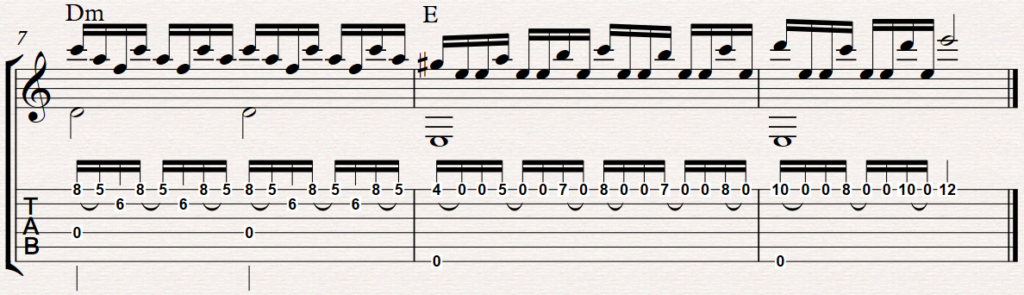
We will be working on one of the most famous chord progression ever played in Spanish music: Am – G – F and E.
I have recorded different fingerstyle lessons on this topic, but today, we will be focusing on transforming this simple chord progression into fast chords that sound melodic and captivating.
First of all, let’s learn the basic triads. Each chord will have three notes except for the E major, which will have a different melody.
Plucking and Pull-Offs
The second step to make these fast chords fluent is to learn the plucking pattern.
The good thing is, the pattern will be the same for the Am, G, and D minor chord.
We will be using a combination of plucking and pull-offs, and each chord will have the same structure of 3-3-2 notes per pattern.
Check the pic below. The Red square indicates the three notes pattern. The right hand for the red square will be the middle finger plucking the first note, then pull off and index finger, plucking the second string.
The Yellow square is the last pattern, which will play two notes only. Pluck these two notes with the middle finger and pull them off.
The E major
The E major chord will have a different melody, but it will keep the same rhythmic plucking pattern of 3-3-2.
I personally love the melody on the E major chord, and even though it can be considered one of the fast chords, it still resonates pretty well with the whole guitar part.
I was inspired by the song Malaguena and particularly by the Michael Lucarelli arrangement.